When we plan a commercial EV charging station, we look at the building’s available electrical capacity. A workplace may have plenty of parking spaces, but that does not mean it can support dozens of chargers at maximum output. The real challenge is matching charging demand with the power that the site can safely provide.
For procurement managers and project engineers, this changes the question. Instead of asking, “How many chargers can we install?”, we would ask, “How can we use the existing capacity more efficiently?”
Start With Employee Charging Behavior
Workplace charging has a useful characteristic: vehicles are usually parked for several hours. Employees may arrive in the morning and leave in the afternoon. That gives the charging system more time to deliver energy.
We would not automatically specify the highest-power charger for every parking space. A 7 kW AC charger may be sufficient for a vehicle parked for most of the working day. An 11 kW or 22 kW unit can serve vehicles with higher daily mileage or shorter parking periods.
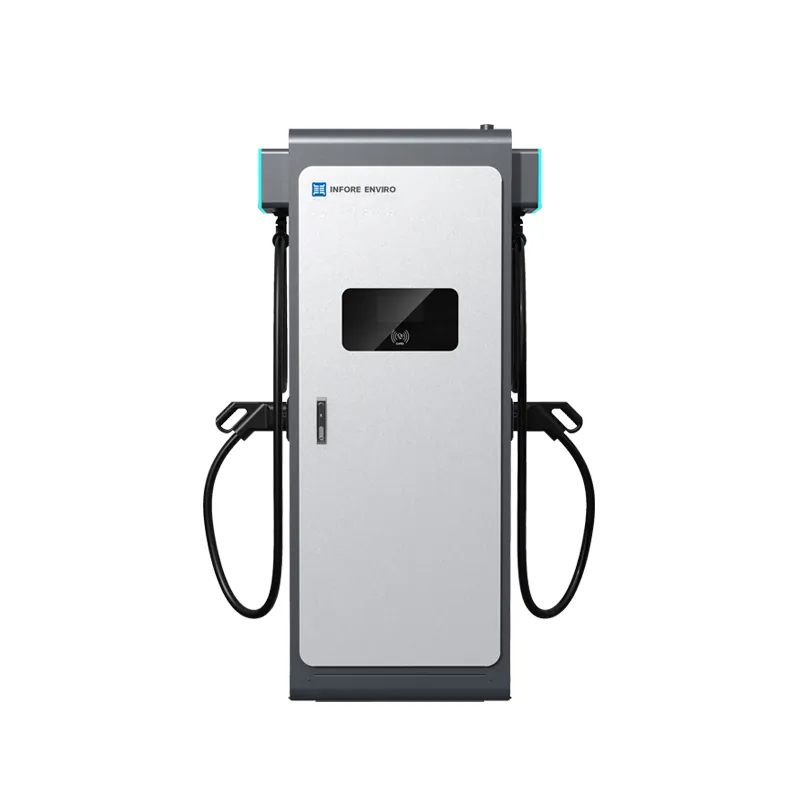
INFORE ENVIRO’s commercial AC portfolio includes 7 kW, 11 kW, and 22 kW options. Its wider product range also includes DC equipment from 30 kW to 480 kW. This allows B2B buyers to consider different charging speeds instead of applying one power level to every workplace.
We find this approach especially useful for office parks and industrial campuses. Employees do not all have the same charging needs. Some may need a small energy top-up, while fleet vehicles may require much more energy before their next shift.
Calculate Available Capacity Before Adding Chargers
The next step is an electrical load assessment. We would check the site’s transformer capacity, distribution boards, existing building loads, and expected charging demand.
A simple example makes the issue clearer. Ten 22 kW chargers have a combined rated capacity of 220 kW. That does not necessarily mean the workplace will continuously consume 220 kW for charging. Actual demand depends on how many vehicles are connected, their battery state, vehicle charging limits, and charging schedules.
This is where load management becomes practical. Instead of allowing every charger to draw maximum power at the same moment, the charging system can distribute available power according to current demand.
For a workplace with limited spare capacity, this can be more useful than immediately upgrading the entire electrical system. It does not create extra electricity. It helps the project use the available electricity more deliberately.
Dynamic Load Balancing Changes the Planning Approach
When we evaluate workplace EV charging stations, we pay close attention to dynamic load balancing. The principle is straightforward: the charging system monitors available power and adjusts charging output when demand changes.
Consider an office building during lunchtime. Building loads may rise because of elevators, air conditioning, kitchen equipment, and other electrical systems. If several vehicles are also charging, the charging system needs to respond to the changing load rather than operate independently.
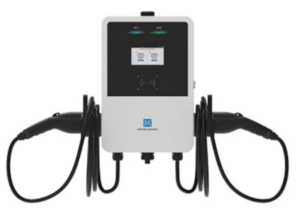
The INFORE ENVIRO Carina commercial floor-mounted charger supports DLB and intelligent charging schedules. It provides 14–42 kW configurations, dual Type 2 charging guns, and IP54 protection. Its communication options include 4G, Wi-Fi, Bluetooth, and Ethernet, while OCPP 1.6J is supported with OCPP 2.0 optional.
For a project engineer, these details matter because load management needs both suitable hardware and communication capability. It should be checked at the product-selection stage, not treated as an afterthought.
AC and DC Can Serve Different Workplace Needs
We also think mixed charging is worth considering. A workplace does not necessarily need every vehicle to use DC fast charging.
AC charging can suit employees who remain parked for several hours. DC charging can be assigned to fleet vehicles, service vehicles, or other vehicles that need a faster turnaround.
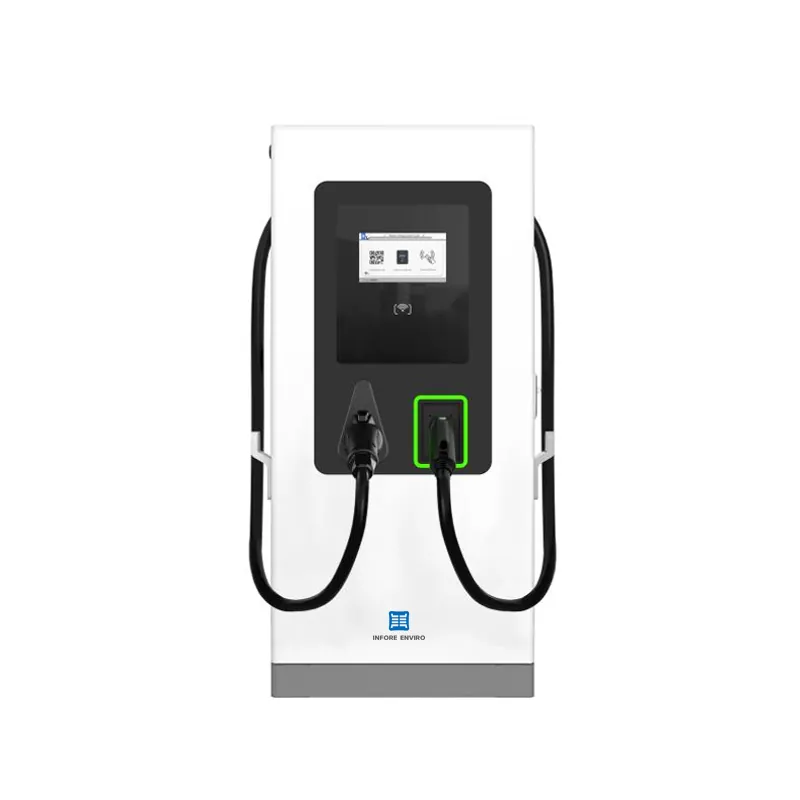
INFORE ENVIRO’s Vector Series combines 60 kW DC and 22 kW AC charging in one unit. It supports CCS2/CCS1 for DC and Type 2 for AC. The unit also supports scheduled charging, smart charging, and DLB load balancing. Its listed protection level is IP54.
This type of configuration can be useful when a site has different charging priorities. Instead of building separate areas for every charging requirement, a project can evaluate whether combined equipment better fits the available space and electrical capacity.
Do Not Ignore Future Expansion
We would also avoid designing a workplace charging project only for today’s vehicle count. EV adoption within a company can increase over time. A system that works for ten vehicles today may need to support fifty vehicles later.
That does not mean installing fifty chargers immediately. It can mean preparing the electrical layout, cable routes, distribution equipment, and communication architecture for phased expansion.
For B2B buyers, this is also where OEM/ODM capability becomes relevant. A manufacturer that supports customized design and hardware configuration can potentially adapt equipment to project requirements. INFORE ENVIRO states that it supports customized design, branding, hardware configuration, software integration, and packaging for distributors, operators, and project customers.
We would discuss these requirements before requesting a final quotation. It is easier to plan expansion during the design stage than to rebuild the infrastructure later.
A Practical Checklist for Procurement Teams
Before ordering equipment, we would prepare a simple site checklist. First, confirm the available electrical capacity. Second, estimate the number of vehicles that may charge simultaneously. Third, record typical parking durations. Fourth, separate regular employee charging from high-demand fleet charging.
Then we would compare the required charging profile with the product specification. Power rating, connector type, input voltage, IP protection, communication protocol, load-balancing capability, and installation method should all be verified for the exact model.
Certification requirements should also match the target market. INFORE ENVIRO’s product portfolio covers configurations and standards including GB/T, Type 2, CCS2, CE, CB, and RoHS according to the relevant product and market. For international B2B procurement, we would confirm the exact certification package for the model being purchased rather than assuming that every product carries identical approvals.
Finally, supplier capacity matters when a workplace project involves multiple sites or phased deployment. INFORE ENVIRO states that it has more than 10 years of EV charging experience and a 12,000-square-metre factory. Its stated lead time is 30–45 days, with a two-year warranty and 7×24-hour after-sales response.
Build Around Available Power, Not Maximum Power
A workplace charging project does not have to begin with a major electrical upgrade. In many cases, the better starting point is understanding when vehicles need energy and how much power the site can provide.
From our perspective, the right equipment should balance charging speed, electrical capacity, load management, future expansion, and site conditions. For B2B buyers, that means comparing the exact technical specification rather than choosing equipment based only on its maximum kW rating.
For distributors and project integrators, INFORE ENVIRO provides AC and DC charging equipment, OEM/ODM customization, and multiple power configurations for different commercial applications.